
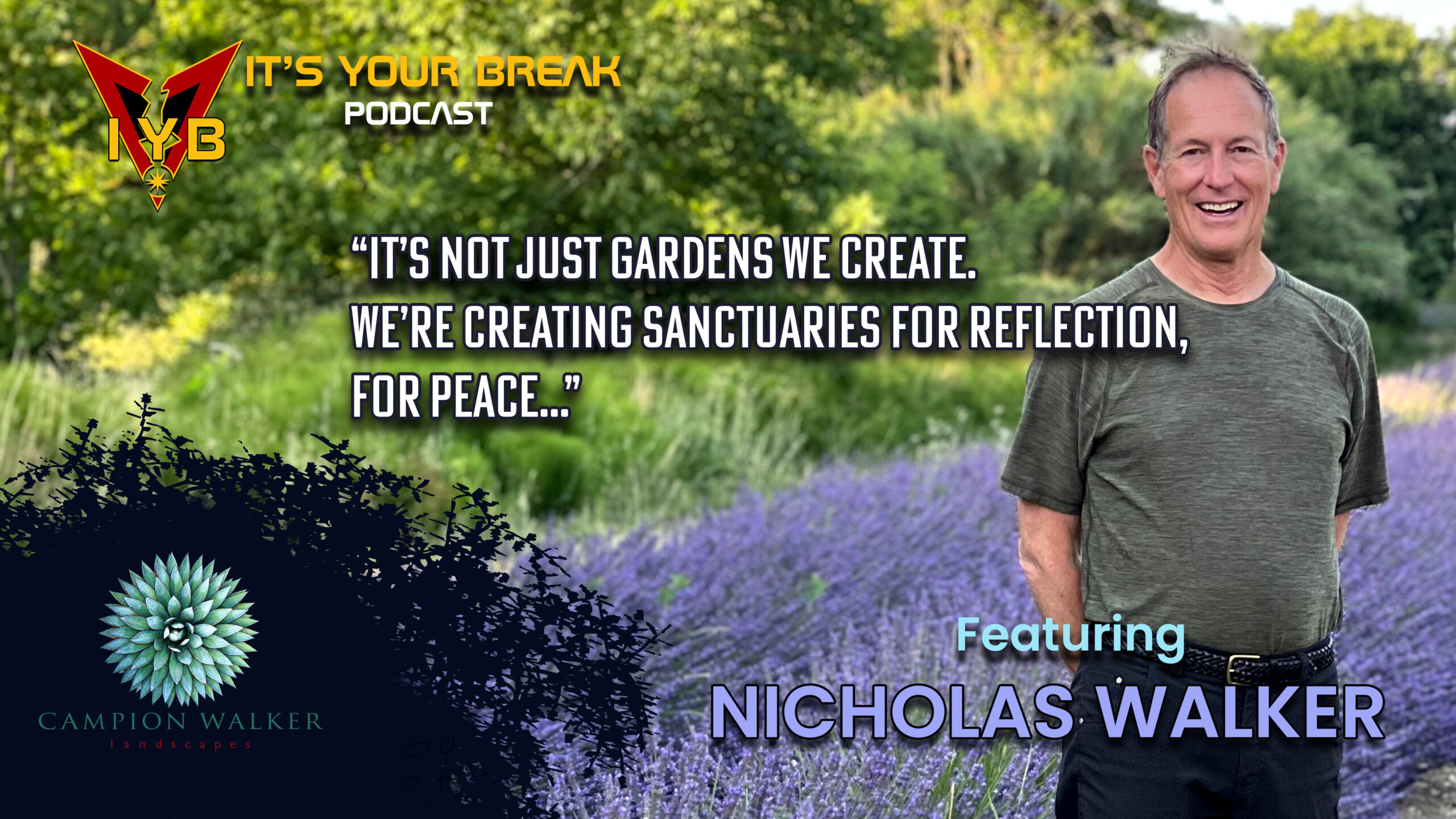
When award-winning landscaper and artist Nicholas Walker sat down with Jonathan Mertz on It’s Your Break, it marked a highly anticipated return after 11 years. Over the past decade, climate events, shifting weather patterns, and ecological shifts have transformed landscaping from a simple aesthetic pursuit into a vital environmental discipline. For Walker—whose career spans over three decades and includes designing for legends like Elizabeth Taylor, Kathy Ireland, Oprah Winfrey, and historic Frank Lloyd Wright properties—the core lesson of a lifetime outdoors remains unchanged: if you do not honor Mother Nature’s principles, she will always win.
Walker’s journey into landscape design began early, nurtured by two grandmothers who were master gardeners. Even during his career as a professional actor, Walker ran his design business directly out of studio dressing rooms between filming calls. That early passion evolved into Campion Walker Garden Design Inc., a firm dedicated to regenerative practices, drought-tolerant plant materials, and microclimate awareness.
A central focus of Walker’s work is firewise landscaping, born from personal experience living in Southern California’s Santa Monica Mountains. Having survived major wildfires—including the 1993 Topanga Fire and recent canyon blazes—Walker emphasizes that fire is an intrinsic component of local canyon ecology. Heavy seasonal rains foster rapid brush and fuel growth, which, combined with 80 mph sustained winds and canyon chimney effects, allows wildfires to travel at 35 miles per hour. Surviving these conditions requires intentional defensible space, clearing combustible deadwood, and avoiding fire-spreading non-native species such as pines, eucalyptus, and unmaintained palm trees with dry fronds. Conversely, native species like coastal live oaks demonstrate remarkable resilience: though they may smoke and burn during a wildfire, they regenerate naturally within three months.
In addition to fire mitigation, Walker advocates for replacing heavy concrete structures with natural ‘naturecapes.’ Rather than erecting massive retaining walls or clearing land with heavy bulldozers, design should follow natural topography. Using local boulders, creating pocket plantings, and installing simple gurgling rocks with automatic overflow fills transforms suburban yards into living sanctuaries. Water features attract pollinators—bees, butterflies, and hummingbirds—restoring biodiversity and bringing dynamic life back into residential spaces.
Walker also highlights the hidden hazards of popular invasive plants. A primary example is the Ficus hedge: while widely chosen for immediate privacy, Ficus roots are exceptionally aggressive, destroying pool shells, lifting coping, and tearing up hardscapes. Walker points to municipal examples such as Pacific Palisades, where maintaining public sidewalks damaged by 70-year-old Ficus trees cost $1 million annually for 20 years before the municipality chose to remove them. Similar ecological disruptions occur when sterile invasive grasses like Pennisetum setaceum or Mexican feather grass seed into wild mountain ecosystems.
Environmental integrity extends directly to maintenance products. Walker strictly banned glyphosate (Roundup) from his practice over 30 years ago due to its proven status as a chemical carcinogen and its long persistence in soil for five to seven years. Maintaining sustainable practices requires standing by environmental principles, even when it means walking away from lucrative commercial contracts that compromise health and safety.
Ultimately, landscape architecture is an art of acute listening—listening to the client, the topography, and the unique composition of the soil. Inspired by the Japanese philosophy of Wabi-Sabi, which celebrates imperfection, natural aging, and asymmetry, Walker views site challenges as creative opportunities. On one project, instead of building an estimated $500,000 concrete retention wall, Walker uncovered and hydro-pressure washed a massive natural stone cliff beneath topsoil, delivering a breathtaking natural facade while saving the client half a million dollars.
As Walker reflects on 50 years in the field, his dedication to listening, learning, and co-creating with nature remains vibrant. True landscape design is not about superimposing human ego onto the earth, but creating enduring sanctuaries that flourish across every season.